
CG Policy · 2025
In this section7 topics
Corporate Governance Policy
Has a Corporate Governance Policy
Yes
Policy Description
The Company is determined to operate business in a fair, transparent and examinable manner under its corporate governance policy. The Board of Directors and the Board of Executive Directors adopt and direct the operational policy of the Company by giving importance to internal control, audit systems and supervising management to ensure that the Company’s objectives and policies are efficiently satisfied within the purview of the laws and the code of business ethics. In the fiscal 2025, the Company complied with the following categories of corporate governance principles
Policy Document Link
https://www.mitsubishi-kye.com/EN/corporate-comp.asp
Policy & Practices — Board of Directors
Has Policy & Guidelines for the Board
Yes
Board Guidelines
| Guideline | Other — Please Specify | Detail |
|---|---|---|
| Nomination of Directors | Nomination and Remuneration of Directors The Board of Directors focuses on transparency in the nomination and selection of individuals to serve as directors. The Nomination Committee is assigned to oversee the recruitment process, taking into account the knowledge, skills, and experience of the Board based on the Board Skill Matrix. This ensures that the required qualifications are aligned with the Company’s business strategies. Furthermore, the Company has established a policy that grants shareholders the right to propose qualified candidates for directorship. The Nomination Committee evaluates the qualifications and suitability of these candidates, as well as directors who are due to retire by rotation or have resigned. The Committee then submits its recommendations to the Board of Directors for approval, after which the nominated individuals are proposed to the Shareholders' Meeting for appointment. In 2025, no candidates were proposed by the shareholders to the Nomination Committee for consideration. Consequently, the Nomination Committee considered the directors who were due to retire by rotation at the 2025 Annual General Meeting of Shareholders (AGM). This evaluation was based on their educational background, skills, work experience, past performance, and their willingness and capability to dedicate time to the Board, as well as qualifications that align with the Company's business strategies. The Board of Directors concluded that all five directors fully met the requirements of the Board composition according to the Board Skill Matrix and were well-aligned with the Company's business strategic direction. Qualifications of Directors Individuals appointed to serve as directors of the Company must possess the required knowledge, capabilities, and readiness to perform their duties. They must meet at least the following qualifications:
Committee Member Composition
Committee Qualification
Nomination and Remuneration Committee was appointed by the Board of Directors, composed of five members:
Duty and Responsibility of the Nomination and Remuneration Committee
Term of service
Meeting
Report
| |
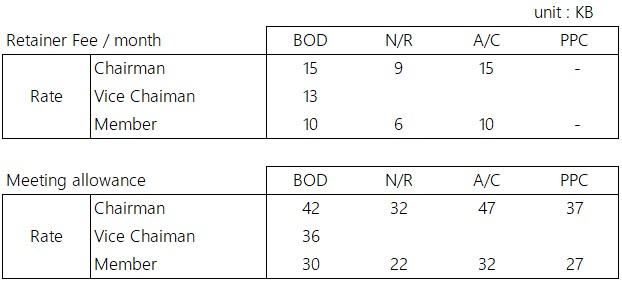
| Determination of Director Remuneration | The Company places great importance on determining director remuneration based on the principles of fairness, transparency, and alignment with the responsibilities, duties, and scope of work of each director. This approach is intended to attract and retain qualified and competent individuals to effectively oversee the Company's operations. The key principles are as follows: Remuneration Determination Criteria
Types of Remuneration Director remuneration is categorized into the following types:
Remuneration Approval Process
Disclosure of Information The Company shall disclose details of director remuneration clearly, transparently, and comprehensively in the Form 56-1 One Report and the Annual Report, including the total amount paid under each type of remuneration. | |
| Board Performance Evaluation | In accordance with the Corporate Governance Code for Listed Companies, the Board of Directors and its sub-committees should conduct an annual self-assessment at least once a year. This practice enables the Board to collectively review performance, identify areas for improvement, and enhance efficiency. Consequently, the Company reviews its evaluation guidelines and assessment criteria annually, at least once a year, utilizing the self-assessment form provided by the Stock Exchange of Thailand (SET). At the Board of Directors’ meeting held on February 12, 2026, the Board approved the performance evaluation for the Board as a whole. The Company Secretary distributed the self-assessment forms to all directors in February 2026 and subsequently compiled the results. The performance evaluation results for the fiscal year 2025 were reported to the Board of Directors' meeting on May 18, 2026. The Board's self-assessment for the year 2025 covers three main categories as follows:
Overall Summary: The Board achieved an overall average score of 3.95 out of a full score of 4. Every assessment topic scored within the "Good to Excellent" range (scoring between 3.0 and 4.0), demonstrating that the Board of Directors performed its duties in accordance with good corporate governance principles at a good to excellent level. Note: Scoring Criteria and Definitions 0 = Strongly disagree, or no action taken on the matter. 1 = Disagree, or minimal action taken on the matter. 2 = Agree, or moderate action taken on the matter. 3 = Strongly agree, or good action taken on the matter. 4 = Entirely agree, or excellent action taken on the matter. Board of Directors' Meetings In the 2025 fiscal year, the Board of Directors held a total of 7 meetings. Other sub-committees also convened throughout the year as follows: the Audit Committee met 4 times, the Product Pricing Committee met 3 times, and the Nomination and Remuneration Committee met 3 times. Additionally, the Executive Committee held meetings twice a month to ensure operational flexibility and efficiency. The majority of directors attended meetings regularly. The individual attendance details of each director are disclosed in Section 8.1.2. Orientation for New Directors For newly appointed directors, the Company organizes an orientation program to provide an overview of the organization, business operations, strategies, and business plans. The orientation also covers the Board of Directors’ Charter, relevant rules and regulations, and other information vital to their roles as directors. This ensures that new directors become familiar with the business and have the opportunity to obtain in-depth insights directly from the relevant executives. | |
| Other guidelines regarding the board of directors | Meeting Protocols | Board of Directors’ Meetings The Company schedules its Board of Directors’ meetings and sets regular agendas in advance on an annual basis. The Company Secretary notifies all directors of the meeting schedule for the entire year in advance, typically at the end of the preceding year prior to the next fiscal year, to enable directors to allocate their time and attend the meetings accordingly. Additional meetings may be convened or schedules may be adjusted as deemed appropriate. Each director is required to attend at least 75% of the total number of Board meetings held in each year, unless there are reasonable and necessary grounds. For each Board meeting, the Chairman of the Board or a designated representative shall send a written notice specifying the meeting date and agenda to the directors at least five working days prior to the meeting date. In urgent cases where it is necessary to protect the rights or interests of the Company, the meeting may be called by other means and scheduled on shorter notice. A quorum of the Board meeting shall consist of not less than one-half of the total number of directors. At the time of voting, there must be no fewer than one-half of the total number of directors present. Each director shall have one vote. Directors who have a vested interest in any matter shall not be entitled to vote on that matter. In the event of a tie vote, the Chairman of the meeting shall have a casting vote. Resolutions of the Board shall be passed by a majority vote of the directors present at the meeting. |
Code of Conduct
Has a Business Code of Conduct
Yes
Code of Conduct Description
The Company adheres to its management philosophy as the guiding principle in conducting business, with a strong awareness of its responsibilities toward society at large. It encourages directors, executives, and all employees to carry out their duties in accordance with the following eight principles of business ethics:
1. Strict Compliance with Laws and Contracts
The Company places utmost importance on legal compliance as a fundamental principle. It shall not enter into any contracts or agreements that violate laws, regulations, or social norms, and shall build trust with business partners through honesty and strict adherence to agreements. Furthermore, it is committed to conducting business in alignment with widely accepted ethical standards.
2. Respect for Human Rights
All business activities are conducted with respect for human rights, without discrimination based on nationality, ethnicity, race, gender, age, beliefs, religion, social status, gender identity, sexual orientation, disabilities, or any other grounds. The Company shall not be involved in any actions that disregard human dignity, such as harassment, defamation, threats, or coercion.
3. Contributing to Society
The Company operates as an enterprise that generates fair profits while remaining mindful of its responsibility to contribute to the overall development and well-being of society.
4. Promoting Harmony in Local Communities
The Company dedicates itself to being a responsible member of local communities by actively participating in community development and social contribution activities.
5. Participation in Building a Sustainable Society
The Company conducts its business with consideration for creating a society that promotes circular resource use and contributes to long-term sustainability.
6. Awareness of Workplace Responsibilities
The Company recognizes its duty as a business operator to protect and manage its assets, including personal data and both tangible and intangible corporate property. It upholds the Company’s image, information integrity, and efficient use of time, refrains from political partisanship, ensures that only factual information is disseminated, and strictly maintains a clear separation between company matters and personal affairs.
7. Fair Relationships with Stakeholders
The Company is aware of its responsibilities to society and all stakeholders, conducting business and building relationships based on fairness and integrity. This fosters cooperation that contributes to the sustainable growth and success of the Company.
8. Managing Conflicts of Interest
The Company has established a strict internal control system to prevent the misuse of authority for personal or group gain. It is committed to transparent, fair, and accountable business practices.
Code of Conduct Link
https://www.mitsubishi-kye.com/en/sustainability/ethic
Code of Conduct Practices
| Guideline | Other — Please Specify | Detail |
|---|---|---|
| Prevention of Misuse of Inside Information | Generally, all decisions made by directors and executives must be in the best interests of the Company. In the event of a conflict of interest, the director or executive must submit the matter to the Board of Directors or the Shareholders’ Meeting, as the case may be, to consider the necessity of the transaction and its potential impact on the Company. In approving transactions that may involve a conflict of interest, any director with a vested interest in the matter shall have no right to vote on that resolution. Furthermore, in compliance with the Securities and Exchange Act, directors and executives are required to prepare and submit a Report of Interest, covering both themselves and their related persons, to the Chairman of the Board and the Chairman of the Audit Committee. Directors, executives, and their related persons are also obligated to report any changes in their Company securities holdings to the Company within three business days from the date of change. The Company Secretary is tasked with forwarding copies of these reports to the Chairman of the Board and the Chairman of the Audit Committee, a process which the Company compiles on a regular semi-annual basis. In addition, the Company strictly governs connected transactions in accordance with the regulations prescribed by the Capital Market Supervisory Board. All related party transactions with affiliated companies are thoroughly disclosed in the financial statements as well as in the Annual Report (Form 56-1 One Report). | |
| Anti-corruption | Anti-Corruption Policy The Company adheres to a management philosophy rooted in social responsibility. We encourage all directors, executives, and employees to perform their duties in accordance with the Company’s Business Ethics and actively oppose all forms of corruption. Appropriate anti-corruption guidelines, risk management training, internal controls, and monitoring systems have been implemented and communicated both internally and externally. This ensures stakeholder confidence, operational transparency, and sustainable organizational growth. Guidelines and Measures
Investigation and Disciplinary Procedures Fact-finding investigations and disciplinary actions regarding corruption are governed by the principles of transparency and fairness, as follows:
Anti-Corruption Implementation The Company has established Anti-Bribery Rules as binding guidelines for the organization, directors, and employees. Furthermore, all employees are required to sign an acknowledgment to reaffirm their commitment to performing duties with honesty and integrity. Other key initiatives include:
| |
| Whistleblowing and Protection of Whistleblowers | Compliance Whistleblower The Company has regulations to support whistleblowing, either seeing any action or behavior from both the organization and the employee who imposes misconduct violates or may infringe on conduct against legal requirements or the Business Ethics. The more promptly the Company can gather and communicate, the more reducible effect will occur to the Company from that action or behavior. Therefore, the Company establishes a Whistle Blower channel for all stakeholders to report clues or complaints encountering any incidents or actions against the law and business ethics that may cause damage to the Company. The Company also has set guidelines and acknowledges all stakeholders every year. Those who witness the above events or actions shall gather information, clues, and evidence to verify the facts as much as possible, then notify directly to the Company by sending feedback or document complaints to the following address.
Attention to: Manager of the Internal Audit Control Office Kang Yong Electric Public Company Limited P.O. Box 49, Bangna Tower 10541 Or send electronic information to E-mail address: hotline@kye.meap.com The Manager of the Internal Audit Office and the investigation team, appointed by the Chairman of the Board of Directors or Managing Director according to the Company announcement, will take into account. It is essential to protect and prevent any impact on the whistleblower as it is confidential information. The Company shall act fairly by referring and proving the information received and quickly decide to take further action on the matter or problem appropriately. To make whistleblowing information purely and fairly and certify the truthful information, the Company requests a specific full name with clear contact. If necessary, the Company may request additional information for consideration of the result of such action. In the past year, the Company receive any information has taken action. | |
| Preventing the Misuse of Inside Information | Management of the Use of Inside Information and the Security of Information and Information Systems The Company has in place measures and policies for managing security of its confidential business information, including not only trade secrets but also other significant information, so as to prevent any leak of such information as well as prevent any executive or work unit that has access to insider information from disclosing it to any third party or any person unrelated to the Company’s business. The Company has therefore established a hierarchy of information secrecy and a framework of responsibility, Including individuals who are authorized to access the information to prevent the use of insider information for personal benefit or for the benefit of other parties, whether directly or indirectly. In addition, the Company discloses the holding of securities by its directors, top management, and finance department manager in the annual report. Any change in such securities holding shall be reported to the SEC under the Section 59 of the Securities and Exchange Act B.E.2535, and also notified to the Company Secretary for preparing a report on change of securities holding and outstanding amount of securities holding by the directors and top management for further submission to the next meeting of the Board of Directors. In 2025, the Company actively monitored and enforced compliance with its policies and guidelines regarding the prevention of insider trading, as established in the Business Code of Conduct, through the following measures:
| |
| Prevention of money laundering | Anti-social Forces Resistance and Anti-money Laundering
| |
| Giving or receiving gifts, entertainment, or business entertainment | Prohibition of Bribery, Improper Gifts, or Entertainment
| |
| Compliance with laws, rules and regulations | Compliance with the Law The Company recognizes legal compliance as a fundamental principle and is committed to conducting its business in alignment with broadly accepted ethical standards in society. | |
| Use and maintenance of data and assets | Confidential Corporate Information Protection
| |
| Anti-competitive | The Company is steadfast in conducting business ethically and transparently based on its management philosophy with awareness of corporate responsibility for the society at large. It encourages the directors, management, and all staff members to perform duty under the code of ethics and in line with the Mitsubishi Electric Group Conduct Guidelines, which the Company first communicated to its employees as work rules in 2007 and has revised from time to time to suit the circumstances, as below: Fair Competition
Furthermore, during the 2025 fiscal year, the Company had no trade disputes with competitors and entered into no anti-competitive agreements or monopolistic arrangements with competitors or other business operators. | |
| Cyber security | The Company has established an Information Security Policy, Privacy Policy, Cookie Policy, Data Logging, Reporting and Retention Policy, and Information Security Standards to serve as operational guidelines for all employees and stakeholders. Dedicated cybersecurity and data protection units have been appointed to oversee data stability and information systems. Additionally, the Internal Audit and Compliance units collaboratively manage and monitor information systems and corporate network security, with risk assessments conducted on an annual basis. Corporate Confidentiality
Performance Results Corporate Network Security Based on system testing by IT and security personnel, suspicious email clicks were detected and successfully blocked. Remedial actions were promptly taken, resulting in zero damage to the organization. Furthermore, the Company actively communicates with employees to raise awareness, prevent incidents, and report information security threats on topics such as:
Cybersecurity The Company has segregated its Wi-Fi network into two separate systems: a restricted system dedicated exclusively to corporate computers, and a general Wi-Fi system serving personal computers, mobile phones, and tablets to accommodate external visitors while maintaining robust cybersecurity capabilities.
Personal Data Protection
| |
| Environmental management | Environmental Policy and Practice The Company is well aware of the importance of the environment; therefore, the policy and goals are clearly defined and reviewed for continuous improvement annually. Employees at all levels have to adhere. According to the 2024 Environmental Management Policy, To realize a prosperous society in which a "sustainable global environment" and a "safe, stable, and comfortable society" by abiding with social norms and laws, as declared in one of the most important management policies, which the Company issues activities entitled to the system as follows:
Environmental Performances The company continues to focus on implementing preventive environmental strategies to increase the efficiency of the production process and reduce risk to humans and the environment by using resources efficiently and clean production (Resource Efficient and Cleaner Production: RECP) and adopting the principle of 3Rs (Reduce, Reuse, Recycle) as a guideline for production activities to make the use of resources worthwhile such as;
| |
| Human rights | Social Policy and Practice The Company focuses on doing business with respect for human rights and responsibility to stakeholders by adhering to the following practices: 1. Respect for Human Rights The Company has established a code of conduct in accordance with the model of the Mitsubishi Electric Group by fostering respect for human rights without discrimination as to nationality, race, religion, social status or disability of its employees. It makes sure that no harassment of human right or discriminative action takes place while upholding a fair practice and ensuring job security for employees at all levels. Job opportunities are provided for non-Thai labor and the disabled as part of its workforce. The Company assigns the employees duties of their capability based on the labour structure under Thai labour laws with proper welfare and benefits conducted by the welfare committee available under the same standards. Moreover, the Company arranges meetings with the labour union on a monthly basis, with a common goal of improving the quality of working life and building up good labour relations between the Company and the employees. As a testament to its relentless efforts in this issue, the Company has received the Workplace with Outstanding Labour Relations and Welfare Management Award from the Department of Labor Protection and Welfare, the Ministry of Labour, for 19 consecutive years. This award has demonstrated an outcome of the Company’s determination in labour relations management with best practices so clearly, and of which the Company, the labour union, and the employees have been proud. 2. Fair Treatment of Labour Salary and Welfare The Company has adjusted its salary structure to be compatible with competition in the labor market and to a rate above the authority’s minimum wage payment as moral support for the employees’ performance of duties. Performance of employees of all levels evaluated twice a year and the results of which used to determine annual promotion and salary increment. Moreover, the Company has set up Workplace Welfare Committee following Labor Protection Act, B.E.2541, Section 96, with employee committee members and management representatives appointed to coordinate with Workplace Welfare Committee in determining welfare structure guidelines beneficial to the employees. Such committee will jointly meet to consider rationalizing basic welfare package in each year in line with the rising cost of living as a way to help cut down expenses for the employees. Employees also provided with the cost of living allowance, diligence allowance, and lunch allowance, as well as improvement of welfare canteen more coverage of medical expenses, annual health check-up, etc. To improve employees’ quality of life, the Company offers additional benefits apart from the basic welfare as below.
| |
| Occupational health and safety | Occupational Health and Safety Policy The Company is always aware that everyone working in the company are a group of people who are the key to moving the organization forward to success and prosperity. Therefore, the company is focusing on creating a workplace culture that “prioritizes the safety, physical health, and mental well-being of everyone working in the company”. Aiming to create a safe, happy, and healthy environment that encourages energy and enthusiasm. This culture relies on everyone taking responsibility for their own safety and their colleagues while implementing initiatives to eliminate dangerous behaviors and hazards. [Safety Slogan] Promoting continuous safety activities through risk-taking prevention and predictive activities. Basic Policy
Occupational Health and Safety Operations 1. Occupational Health, Safety and Environment The Company incorporates occupational health, safety, and environment into the yearly policy and action plan so that the executives, supervisors, and staff at all levels will cooperate in the implementation according to the policy consistently and efficiently. The Occupational Health, Safety and Environment Committee has set up composed of senior executives, supervisors at all levels and the labor union to ensure compliance with ISO 14001 environmental management standards and occupational health, safety and environment rules and regulations, as follows:
2. Safety Outside Office Hours Individual employees are deemed not only as a driving force for the Company’s business operation to move forward with success, but also as a tower of strength for their family. Therefore, they must be both mentally and physically healthy to be ready for their work, especially for those who work in risk-prone and unsafe areas or even those whose working areas are risk-free. The Company provides welfare and arranges health-concern activities for the employees, such as anti-drug sports competition, don’t drive drunk campaign from the eve of long holidays to enhance social responsibility awareness in order to prevent accidents during employees’ trips back home upcountry and back to work, random drug and alcohol testing on staff shuttle bus drivers, and safety helmet campaign for staff who use motorcycles. Traffic accidents should be reported in order to increase awareness of traffic accidents and ensure their highest safety. In addition, emergency report is put in place in case of staff having an accident outside office so that first-aid and urgent support can be timely provided. | |
| Other guidelines related to business code of conduct | Information Disclosure and Transparency | The Company has disclosed information as required by the SET, such as financial reports, changes of directors and members of board committees, approval of connected transactions, etc., via the SETLink system after every Board of Directors’ meeting or shareholders’ meeting and already published such information in the annual report and annual registration statement (One Report) covering report on operating results, financial statements, management’s discussion and analysis, and report on the Board of Directors’ responsibility for the financial statements to ensure transparency for the benefits of the shareholders. Investors can also ask for more information by contacting its Investor Relations Division at telephone number 02-337-2900 Ext. 1120 or at e-mail: information@kye.meap.com |
| Other guidelines related to business code of conduct | Responsibility for Supply Chain | The Company has systematically, scrupulously and formulated a socially responsible procurement policy, entailing procurement control, supply source assessment, supplier selection etc. In doing so, it adheres to the ethical standards on “discharge of duty with integrity and righteousness while maintaining a cordial relationship with business partners” through mutually supporting cooperation as if being alliances in terms of technology, safety, output expansion, environmental problem reduction, and quality standard upgrade, so that they could move together toward business strength and stability. |
| Other guidelines related to business code of conduct | Innovation and Publicizing of Innovation from CSR Activities | The company is committed to promoting a culture of innovation within the organization to enhance competitiveness, respond to market dynamics, and create long-term value for all stakeholders. This is achieved through the following approaches: 1. Establishment of an Innovation Unit The Innovation Development Department was established to drive the creation and development of new approaches in manufacturing processes, management, and product design in collaboration with the production department. 2. Development of Learning and Experimentation Support Systems The company promotes learning in emerging technologies and concepts such as AI, Digital Manufacturing, and ESG principles through both internal and external training programs. 3. Creation of Platforms for Idea Exchange and Expansion Cross-departmental meetings are organized to facilitate the exchange of ideas and creative concepts, along with feasibility studies to assess potential integration into production processes. 4. Development of Collaborative Innovation Networks The company collaborates with ME Group affiliates and external partners, including research institutions and academic organizations, to expand knowledge and jointly develop new technologies. 5. Integration of Innovation into Corporate Strategy Innovation is positioned as a core corporate value and is integrated into strategic goals, including the development of environmentally friendly products that meet the needs of modern lifestyles. 6. Recognition and Motivation The President Awards are organized as a platform for employees to present innovative projects or ideas, aiming to foster motivation, creativity, and continuous improvement. |
Promoting Compliance with the Code of Conduct
Promotes Compliance by Directors, Executives and Employees
Yes
Description
Responsibility of the Board of Directors
The Company operates business by upholding the code of business ethics and business administration philosophy and is well aware of its corporate responsibility for the society at large. It encourages the directors, the management and all staff members to discharge duty under eight aspects of business ethics, encompassing compliance with laws, respect for human rights, contribution to society, creation of unity in the local community, participation in environmental problem solving, awareness of one’s duty as a workplace member, promotion of good cooperation with stakeholders, and management of conflict of interest by putting in place a rigid control process to ensure a fair and transparent business operation.
At present, five out of the total 14 board members of the Company are independent directors, which is in compliance with the corporate governance practices requiring that at least one-third of the total number of directors should be independent directors. This helps to ensure that the shareholders’ rights and benefits will be taken care of, and the Company’s benefits fully protected. It also leads to checks and balances in the board structure since 9 of them are non-executive directors and 5 are executive directors. Under such board composition, the non-executive directors are able to render opinion fully and independently in the consideration on all issues at the board meeting.
The Company has segregated the position, power and duty, and persons between the board chairman and the president to maintain checks and balances between them. The Company also established the Board of Executive Directors to consider essential matters with due care and for the utmost benefit.
In 2025, the Company actively monitored and enforced compliance with its Business Code of Conduct policies and guidelines, including the prevention of conflicts of interest and insider trading. The General Administration Department, in collaboration with the corporate group and relevant departments, developed E-Learning modules and assessments on the Business Code of Conduct. In the past year, employee participation reached 100%. Additionally, a Compliance Week was organized to enable executive directors, executives, and employees to review essential concepts and required protocols. For the fiscal year 2025, there were no reported violations of the Code of Conduct in any category.
Head of Compliance
Mr. Atakrit Siwasarit
General Manager of Corporate Planning & Administration Division / Chief Compliance Officer (CCO)
The Chief Compliance Officer is appointed by the Managing Director and holds the following responsibilities:
Plan and execute the legal and regulatory compliance roadmap.
Assist the Managing Director in ensuring that compliance programs are consistently implemented and updated.
Promote, support, and empower Division Compliance Leaders in executing compliance operations.
Anti-Corruption Networks & Projects
Joined or Declared Intent to Join Anti-Corruption Networks
No
Networks & Projects Joined
| Network / Project |
|---|
| Thai Private Sector Collective Action Against Corruption: CAC |
| Thai Private Sector Collective Action Against Corruption: CAC |
| United Nations Global Compact (UNGC) |
| United Nations Global Compact (UNGC) |
| Participation of anti-Corruption networks and initiatives |
| Participation of anti-Corruption networks and initiatives |
Material Changes & Developments in CG
Reviewed the CG Policy or Board Charter in the Past Year
Yes
Material Changes or Developments in the Past Year
No
Implements the CG Code for Listed Companies
No
CG Code — Description
Good Corporate Governance
Kang Yong Electric Public Company Limited (the “Company”) recognizes the importance of good corporate governance in accordance with the Corporate Governance Code (CG Code) for listed companies issued by the Securities and Exchange Commission (SEC). The Company has adopted and applied the CG Code appropriately to suit the nature of its business, aiming to conduct operations with transparency, accountability, and long-term value creation for shareholders and all stakeholders. The Company’s key practices are as follows:
Responsibilities of the Board of Directors
The Board of Directors is responsible for setting the Company's policies, strategic direction, and overseeing its operations to ensure efficiency, transparency, and adherence to governance principles. The Board performs its duties independently, prudently, and with accountability, focusing on the long-term best interests of shareholders.
Defining Objectives to Promote Sustainability
The Company conducts business with a strong sense of responsibility toward society, the environment, and all stakeholder groups. Business objectives are aligned with sustainable value creation alongside economic growth.
Board and Executive Recruitment
The Company has in place a structured process for the recruitment and evaluation of directors and senior executives, taking into account competence, integrity, and continuity in leadership.
Board Performance Evaluation
The Company emphasizes regular performance evaluations of the Board of Directors and its subcommittees to enhance effectiveness and strengthen corporate governance practices.
Promoting an Ethical Corporate Culture
The Company has established a Business Code of Conduct and an Ethics Handbook as operational guidelines for all employees. Directors and executives are expected to serve as role models and promote integrity throughout the organization.
Risk Management and Internal Control
The Company continuously assesses and manages business risks and has implemented an effective internal control system under the oversight of the Audit Committee. This ensures operational efficiency and compliance with applicable laws and regulations.
Disclosure and Communication
The Company is committed to accurate, complete, timely, and fair disclosure of information through appropriate channels such as the annual report, the Company’s website, and shareholders’ meetings. This fosters transparency and builds trust among stakeholders.