
Board Performance · 2025
In this section14 topics
- Compliance Monitoring — Overview1 item
- Prevention of Conflicts of Interest3 items
- Prevention of the Use of Inside Information3 items
- Anti-Corruption4 items
- Whistleblowing4 items
- Selection of Directors & Chief Executives5 items
- Selection of Independent Directors2 items
- Evaluation of Board & Subcommittee Performance2 items
- Subcommittees1 item
- Meeting Attendance & Remuneration3 items
- Supervision of Subsidiaries & Associated Companies4 items
- Board Duty Performance — Overview1 item
- Audit Committee Duty Performance1 item
- Executive Committee Duty Performance1 item
Compliance Monitoring — Overview
Monitoring of Compliance with Other CG Policies & Guidelines
Information Disclosure and Transparency
The Company has disclosed information as required by the SET, such as financial reports, changes of directors and members of board committees, approval of connected transactions, etc., via the SETLink system after every Board of Directors’ meeting or shareholders’ meeting and already published such information in the annual report and annual registration statement (One Report) covering report on operating results, financial statements, management’s discussion and analysis, and report on the Board of Directors’ responsibility for the financial statements to ensure transparency for the benefits of the shareholders. Investors can also ask for more information by contacting its Investor Relations Division at telephone number 02-337-2900 Ext. 1120 or at e-mail: information@kye.meap.com
Head of Investor Relations
The Company has established an Investor Relations Department to facilitate communication and provide accurate information and understanding regarding the Company’s data and operations to investors, shareholders, analysts, and relevant organizations. Mr. Mongkol Thadtayatikom, Manager of the Corporate Strategic Planning Office, serves as the Head of Investor Relations.
The Investor Relations Department can be contacted at:
Mr. Mongkol Thadtayatikom
Telephone: 02-337-2900 ext. 1120
E-mail: information@kye.meap.com
Prevention of Conflicts of Interest
Has the Company Acted to Prevent Conflicts of Interest?
Yes
Operations in the Past Year
The directors and the management must make any decision and action for the Company's best interests. If there is a conflict of interest, directors or executives will bring such matters to the Board of Directors or the shareholders' meeting to consider the necessity of doing the said transaction and the impact that will occur, as the case may be. In considering and approving transactions that may cause conflicts of interest, directors with interests in such transaction will not be able to vote in that resolution. In addition, the new Securities and Exchange Act has assigned the Company’s directors and executives to prepare reports on their interests and related persons for the Company to acknowledge. The Act also stated that directors, the management, and their related persons are responsible for preparing a report on the change in holding the Company's securities within three business days after the transition to the Company. The corporate secretary is eligible for sending copies to the Chairman of the Board of Directors and the Chairman of the Audit Committee every six months regularly. Besides, the Company has reported the connected transactions following the Securities and Exchange Commission (SEC) rules, which were disclosed in the financial statements and the annual registration statement.
Number of Conflict-of-Interest Cases
| Metric | Current Year | Previous Year | Two Years Ago |
|---|---|---|---|
| Total number of cases or issues related to conflicts of interest (cases) | 0 | 0 | 0 |
Prevention of the Use of Inside Information
Has the Company Acted to Prevent the Use of Inside Information?
Yes
Operations in the Past Year
Control of Insider Information
The Company has in place measures and policies for managing security of its confidential business information, including not only trade secrets but also other significant information, so as to prevent any leak of such information as well as prevent any executive or work unit that has access to insider information from disclosing it to any third party or any person unrelated to the Company’s business. The Company has therefore established a hierarchy of information secrecy and a framework of responsibility, Including individuals who are authorized to access the information to prevent the use of insider information for personal benefit or for the benefit of other parties, whether directly or indirectly.
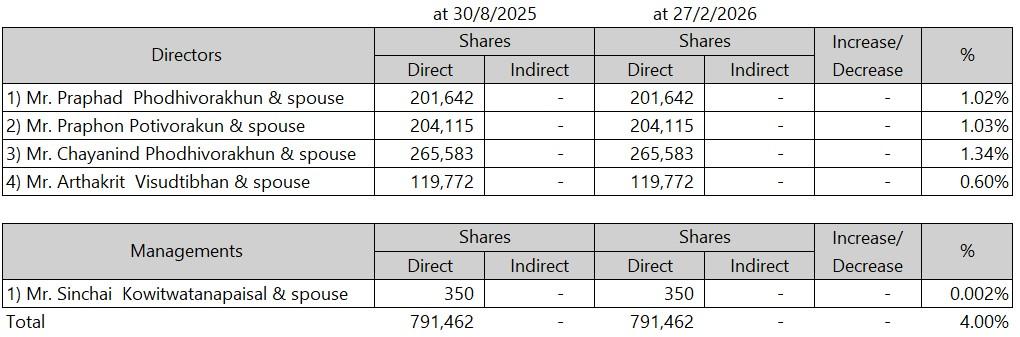
In addition, the Company discloses the holding of securities by its directors, top management, and finance department manager in the annual report. Any change in such securities holding shall be reported to the SEC under the Section 59 of the Securities and Exchange Act B.E.2535, and also notified to the Company Secretary for preparing a report on change of securities holding and outstanding amount of securities holding by the directors and top management for further submission to the next meeting of the Board of Directors.
Report on Securities Holding of Directors and Executive Management
Number of Inside-Information Cases
| Metric | Current Year | Previous Year | Two Years Ago |
|---|---|---|---|
| Total number of cases or issues related to the use of inside information to seek benefits (cases) | 0 | 0 | 0 |
Anti-Corruption
Has the Company Acted on Anti-Corruption?
Yes
Operations in the Past Year
Anti-Corruption Policy
The Company has a policy against corruption announcing on the Company's website to enable all directors, executives, and employees to perform their duties under the Company's business ethics and to fight against corruption in all forms. To build confidence in the Company's stakeholders, the Company has set up the appropriate anti-corruption guidelines and measures, clear anti-corruption training for employees and anti-corruption communication both internally and externally.
Anti-Corruption actions
The Company has Anti-Bribery Rules, which is a requirement and guideline for the Company, directors, and employees to comply with and requires all employees to operate their work with honesty and express their awareness of their duties and responsibilities. In addition, an operational ethics risk assessment was conducted in 2025, which indicated that the risk remained at a low and acceptable level.
Other important actions
Requested cooperation from the supplier to refrain from giving any gifts to executives or employees in the New Year season and any other festival.
The Company regularly organizes training sessions to build understanding of laws and other regulations, alongside continuous campaigns to raise awareness among employees. This includes mandatory courses via the ME-Learning system, requiring 100% participation from both executives and employees, as well as educational exhibitions. In 2025, the Company organized 'Compliance Week,' which attracted a total of 953 participants, accounting for 58% of the total target group. Additionally, the 'Compliance E-learning' program achieved 100% participation from its target group, with a total of 437 participants.
Form of Anti-Corruption Operations
| Operation |
|---|
| Review of appropriateness in anti-corruption |
| Assessment and identification of corruption risk |
| Communication and training for employees on anti-corruption policy and guidelines |
| The monitoring of the evaluation of compliance with the anti- corruption policy |
| Review of the completeness and adequacy of the process by the Audit Committee or auditor |
Number of Corruption Cases
| Metric | Current Year | Previous Year | Two Years Ago |
|---|---|---|---|
| Total number of cases or issues related to corruption (cases) | 0 | 0 | 0 |
Whistleblowing
Has the Company Implemented Whistleblowing Procedures?
Yes
Operations in the Past Year
Whistleblowing system
The Company has regulations to support whistleblowing, either seeing any action or behavior from both the organization and the employee who imposes misconduct violates or may infringe on conduct against legal requirements or the Business Ethics. The more promptly the Company can gather and communicate, the more reducible effect will occur to the Company from that action or behavior. Therefore, the Company establishes a Whistle Blower channel for all stakeholders to report clues or complaints encountering any incidents or actions against the law and business ethics that may cause damage to the Company. The Company also has set guidelines and acknowledges all stakeholders every year. Those who witness the above events or actions shall gather information, clues, and evidence to verify the facts as much as possible, then notify directly to the Company by sending feedback or document complaints to the following address.
Attention to: Manager of the Internal Audit Control Office
Kang Yong Electric Public Company Limited
P.O. Box 49, Bangna Tower 10541
Or send electronic information to
E-mail address: hotline@kye.meap.com
The Manager of the Internal Audit Office and the investigation team, appointed by the Chairman of the Board of Directors or Managing Director according to the Company announcement, will take into account. It is essential to protect and prevent any impact on the whistleblower as it is confidential information. The Company shall act fairly by referring and proving the information received and quickly decide to take further action on the matter or problem appropriately. To make whistleblowing information purely and fairly and certify the truthful information, the Company requests a specific full name with clear contact. If necessary, the Company may request additional information for consideration of the result of such action. In the year 2025, the Company receive any information has taken action.
Number of Whistleblowing Cases
| Metric | Current Year | Previous Year | Two Years Ago |
|---|---|---|---|
| Total number of cases or issues received through whistleblowing channels (cases) | 1 | 1 | 1 |
Details of Whistleblowing Cases
| Status | Period Type | Start of Period | End of Period | Details of the Case or Issue | Investigation Results | Corrective Actions | Case or Issue |
|---|---|---|---|---|---|---|---|
| Incident no longer subject to action | Within (month/year) | 2025-07 | 2025-07 | Non-compliance with laws, rules, and regulations was identified. | Verified Non-Compliance | A verbal warning was given to enforce legal compliance. | 3190 · Description: Compliance with laws, regulations, and rules |
Selection of Directors & Chief Executives
Are Directors Selected Through the Nomination Committee?
Yes
Are Chief Executives Selected Through the Nomination Committee?
Yes
Number of Directors from Major Shareholders
4
Rights of Minority Shareholders on Director Appointment
Rights of Shareholders
The Company recognizes the rights of shareholders to access correct and adequate information of the Company on a timely and equal basis. The Company submits notice of the shareholders’ meeting together with documents containing complete and sufficient information for the meeting to the shareholders in advance as required by laws and providing important details of the proposed issues, rationale and necessity, and the opinion of the Board of Directors. Those who are not convenient may appoint a proxy or any of the Company’s independent directors, who also are members of the Audit Committee, to attend the meeting and cast votes on their behalf. Moreover, the information is made available through the Stock Exchange of Thailand’s SET Portal Straight Through system.
The Company sets to hold an annual general meeting of shareholders within 4 months from the end of the fiscal year. In 2025, the Company convened one annual general meeting of shareholders on Friday, July 25, 2025 via electronic media (E-AGM) in accordance with the Emergency Decree E-meetings, 2563 B.E. The meeting system and broadcast live were from meeting room 121, Kang Yong Electric Public Company Limited to enable the shareholders to consider, comment or vote on the proposed issues properly at the meeting. Members of the Board of Directors, the Audit Committee and other Board committees, as well as the certified public accountants and the management of the Company, were present at the meeting to answer all queries raised by the shareholders on an equitable basis. Questions and answers were correctly and completely recorded in the minutes of the shareholders’ meeting. The Board of Directors prepared the minutes of the shareholders’ meeting and made it available on the Company’s website within 14 days after the meeting date for the shareholders’ ease of reference and examination.
The meeting was carried out as in the order set in the agenda without addition of any items. E-meeting for registration and to view the live audio-visual system from the meeting, using the E-Voting system to vote on each agenda.
Equitable Treatment of Shareholders
The Company fully conforms to the code of best practices in relation to rights of the shareholders. In particular, the shareholders are given the right to propose agenda items for the annual general meeting and/or to nominate candidates for director election in advance, thus signifying a fair treatment of all shareholders. For the 2025 Annual General Meeting of Shareholders, the Company arranged for the shareholders to propose agenda items for the said meeting and/or nominate qualified persons for director election in advance during January 18 – March 17, 2025, and so notified the shareholders through the SET. Moreover, the Company posted information on its website at www.mitsubishi-kye.com, giving details about the procedure and method of consideration in a clear and transparent manner. For the 2025 Annual General Meeting of Shareholders, none of the shareholders proposed agenda items for such meeting and/or nominated qualified candidates for director election.
As for the 2026 Annual General Meeting of Shareholders, scheduled to be held in this July, the Company has similarly given the shareholders the right to propose agenda items for the meeting and/or to nominate candidates for director election in advance, by forwarding their proposed agenda items and director nomination to e-mail address at information@kye.meap.com or registered mail during January 16 - March 16, 2026, the matter of which was already notified by the Company to the SET, none of the shareholders proposed agenda items for such meeting and/or nominated qualified candidates for director election.
The Company has also provided convenience to non-Thai shareholders by making available meeting notice and relevant meeting documents in English version to communicate with non-Thai shareholders with due regard to their equitable rights as the shareholders of the Company.
Method of Director Appointment
| Method |
|---|
| Method whereby each director requires approval votes more than half of the votes of attending shareholders with voting rights |
Selection of Independent Directors
Criteria for Selecting Independent Directors
Nomination of Independent Directors
The Company considers its independent directors’ qualifications based on the criteria set forth in notification of the Capital Market Supervisory Board, as follows:
1. Not holding shares more than 1% of the total number of voting shares of the company’s its subsidiary, major shareholders or controlling persons including shares held by related persons of the independent director.
2. Not being or having previously been an executive director, employee, staff or advisor who receives a regular salary of the Company or a controlling person of the Company or its associates or major shareholder, unless the foregoing status ended not less than two years prior to the date of appointment.
3. Not being a person related by blood or registration under law, such as a father, mother, spouse, sibling, or child, including spouses of children of others directors, executives, major shareholders, controlling persons, or persons to be nominated as directors, executives or controlling persons of the Company or its associates. 4. Not having or having previously had a business relationship with the Company, its subsidiary, major shareholder or controlling person, in a manner which may interfere with the independent director’s independent judgment; and not being or having previously been a substantial shareholder or controlling person of the Company, unless the foregoing status ended not less than two years prior to the date of appointment.
5. Not being or having previously been an auditor of the Company, its associates, major shareholder or controlling person; nor being a substantial shareholder, controlling person or partner of an audit firm which employs auditors of the Company, its associates, major shareholder or controlling person, unless the foregoing relationship ended not less than two years from the date of appointment.
6. Not being or having previously been any kind of professional advisor including a legal advisor or financial advisor who receives an annual service fee exceeding two million baht from the Company, its subsidiary, major shareholder or controlling person; and not being or having previously been a substantial shareholder, controlling person or partner of the professional advisor, unless the foregoing relationship ended not less than two years from the date of appointment. 7. Not being appointed as a representative of the Company’s director, major shareholder or a shareholder who is a related person of the major shareholder.
8. Not conducting any business which is of the same nature as, or in competition with, the business of the Company or its associates in material aspect; nor being a substantial partner of a partnership, or an executive director, employee, staff or advisor who receives a regular salary, or a shareholder holding more than 1% of the total number of voting shares of any entity whose business is of the same nature as and in competition with the business of the Company or its subsidiary in any material aspect.
9. Not possessing any other characteristics which lead the independent director to be unable to render independent opinion regarding business affairs of the Company.
Did Any Independent Director Have a Business or Professional Relationship?
No
Evaluation of Board & Subcommittee Performance
Criteria for Evaluating Board Performance
Self-Assessment of the Board of Directors
According to the Corporate Governance Code (CG Code) for Listed Companies, the Board of Directors and its Sub-Committees are required to conduct a self-assessment at least once a year. This allows the Board to collectively review their performance and identify areas for improvement. Consequently, the Company reviewed its assessment guidelines and criteria to ensure appropriateness, aligning them with the self-assessment forms provided by the Stock Exchange of Thailand (SET). At the Board of Directors’ meeting held on February 12, 2026, the Board approved the policy to conduct a self-assessment on an annual basis, at least once a year. The year 2026 marks the tenth consecutive year that this process has been implemented; therefore, the assessment was conducted on a committee-wide basis. In February 2026, the Company Secretary distributed the self-assessment forms to all directors, subsequently compiled the results, and reported the performance evaluation results for the fiscal year 2025 to the Board of Directors' meeting on May 18, 2026.
The Board’s self-assessment results for the fiscal year 2025 comprise the following three categories:
Structure and Qualifications of the Board of Directors
Board of Directors’ Meetings
Roles, Duties, and Responsibilities of the Board of Directors
Evaluation of Board Performance in the Past Year
In conclusion, the earned average score is 3.95 out of the full score of 4 All criteria points have good average score (in a 3.0 - 4.0 range), reflecting the Board’s performance of duties according to the good corporate governance principles at a well to excellent level.
Note: Scoring system and definition:
0 = Strongly disagree or never conducted
1 = Disagree or seldom conducted
2 = Fair or moderately conducted
3 = Agree or well conducted
4 = Strongly agree or excellently conducted
In fiscal 2025, the Company held a total of 7 Board of Directors’ meetings. Meetings of other board committees consisted of 4 meetings of the Audit Committee, 3 meetings of the Product Pricing Committee, and 3 meeting of the Nomination and Remuneration Committee. In contrast, the Board of Executive Directors holds meetings twice a month to enable the Company to carry on its operations with flexibility and efficiency. Most of the directors regularly attended meetings. Details of meeting attendance by the individual directors are as follows:
Subcommittees
Subcommittees
| Results of the Subcommittee's Duty Performance |
|---|
In 2024, the Nomination and Remuneration Committee convened a total of three meetings, held on May 9, 2025, November 10, 2025, and March 25, 2026 Key agenda items included: 1. Adopt of the minutes of the previous meeting. 2. Nomination of directors to replace those retiring by rotation, considering directors whose terms had expired. 3. Consideration of directors’ remuneration for 2025, proposing a total remuneration budget not exceeding THB 6.5 million, the same amount as in 2024. 4. Nomination of a new director to replace a resigned director Throughout the year, the Nomination and Remuneration Committee has performed its duties effectively, covering director nominations, annual remuneration proposals, and adjustments to the structure of various board committees. These efforts have ensured continuity, transparency, and adherence to principles of good corporate governance in the company’s management. |
In 2025, the Product Pricing Committee held a total of three meetings and played a key role in reviewing pricing strategies for each product group to ensure alignment with changing market conditions and cost structures. The key highlights of the Committee’s performance are as follows:
In conclusion, the Product Pricing Committee has fulfilled its duties with diligence, transparency, and efficiency, in accordance with good corporate governance principles, to support the company’s sustainable growth. |
Meeting Attendance & Remuneration
Justification for Directors' Non-Attendance
There is another critical meeting
Types of Remuneration of the Board of Directors
Director Remuneration Policy
The Company places importance on determining directors’ remuneration based on principles of fairness, transparency, and alignment with the responsibilities, duties, and scope of work of each director. The objective is to incentivize qualified and competent individuals to effectively perform their duties in overseeing the Company’s governance. The key principles are as follows:
1. Remuneration Criteria
Consideration is given to the scope of responsibility for each directorial position, as well as the knowledge, capabilities, and experience that benefit the Company.
The remuneration must be appropriate and consistent with the Company’s performance and business scale.
Benchmarking is conducted against peers in the same industry and directors’ remuneration data from listed companies of comparable size.
2. Types of Remuneration
Directors’ remuneration is categorized into three types:
(1) Monthly Retainer Fees – paid to each member of the board and subcommittees.
(2) Meeting Allowances – determined based on the number of meetings attended by each director.
(3) Other Remuneration – if any.
3. Remuneration Approval Process
The Nomination and Remuneration Committee proposes the structure and rates of directors’ remuneration to the Board of Directors.
The Board of Directors considers and endorses the proposal before presenting it for approval at the Shareholders’ Meeting.
4. Disclosure
The Company discloses all types of directors’ remuneration clearly, transparently, and comprehensively in the Form 56-1 One Report and Annual Report, indicating the total amount paid for each type of remuneration.
Remuneration or Benefits Payable to the Board
| Metric | Amount (Baht) |
|---|---|
| Remunerations or benefits pending payment to the board of directors over the past year (baht) | 0 |
Supervision of Subsidiaries & Associated Companies
Does the Company Have Subsidiaries or Associated Companies?
Yes
Is There a Mechanism for Overseeing Subsidiaries and Associated Companies?
Yes
Mechanism for Overseeing Management of Subsidiaries
The Company’s Board of Directors recognizes the importance of safeguarding the Company’s investment interests in associate companies and has therefore established an effective governance mechanism to oversee and control their operations. The Executive Committee has resolved to appoint one director or senior executive of the Company to serve as a board member of the associate company. This representative is responsible for participating in the formulation of key business policies, approving or endorsing significant matters, providing opinions, and closely monitoring the associate company's performance. In addition, the appointed representative plays an active role in offering strategic guidance, tracking business progress, and regularly reporting to the Company’s Board of Directors. This ensures timely evaluation of investment performance and enables sound strategic decision-making. Such oversight aligns with the principles of good corporate governance and supports the sustainable creation of long-term value for shareholders.
Oversight Mechanisms
| Mechanism |
|---|
| Sending representatives to act as directors, executives or controlling persons in proportion to shareholdings |
| Defining the scope of powers, duties and responsibilities of directors and executives who represent the company in setting important policies |
Board Duty Performance — Overview
Board Duty Performance — Overall Description
In the past year, the Board of Directors has performed its duties with prudence, transparency, and a strong commitment to the principles of good corporate governance. The Board has emphasized good governance practices, long-term sustainability, and the enhancement of the company’s competitiveness. The key highlights of its operations are as follows:
1. Nomination and Appointment of Directors and Top Management
2. Self-Assessment of the Board of Directors
3. Attendance of Directors
4. Directors’ remunerations
5. Monitoring of Associated Companies
6. Control of Insider Information
7. Information Disclosure and Transparency
8. Prevention of Conflicts of Interest
9. Anti-Corruption
10. Compliance Whistleblower
11. Responsibility of the Board of Directors
Audit Committee Duty Performance
Results of the Audit Committee's Duty Performance in the Past Year
Audit Committee Report
The Audit Committee of Kang Yong Electric Public Company Limited, appointed by the Board of Directors, consists of three independent directors: Mr. Arthakrit Visudtibhan as the Chairman, Police Major General Sahaschai Indrasukhsri, and Dr. Apichai Boontherawara. The Board of Directors passed a resolution appointing Dr. Apichai Boontherawara as the member possessing sufficient knowledge and experience to review the reliability of the Company’s financial statements.
During the fiscal year 2025 (April 2025 – March 2026), the Audit Committee performed its duties independently within the scope of responsibilities specified in the Audit Committee Charter, which complies with the regulations of the Stock Exchange of Thailand (SET) and the Securities and Exchange Commission (SEC). The summary of significant activities is as follows:
1. Review of Financial Report
The Audit Committee reviewed the significant information of the quarterly and annual financial statements for the fiscal year 2024. This was conducted by listening to clarifications and inquiring about material issues with the external auditors and the Company’s Financial Manager. The Committee expressed the opinion that the aforementioned financial statements were accurate, complete, sufficiently disclosed, and reliable in accordance with Generally Accepted Accounting Principles (GAAP). Furthermore, the external auditors reported on their independence in performing duties and presented all findings from the audit to the Audit Committee for consideration.
In addition, the Audit Committee acknowledged the material substance and coordinated actions regarding changes in relevant accounting and financial reporting standards.
2. Review of Risk Management
The Audit Committee considered the risk management policy, risk assessment, work plans, and risk management guidelines. The Company has established a Risk Management Committee, chaired by the Managing Director, with a working group comprising various management divisions. This working group is responsible for identifying risks that might affect the Company’s operations, evaluating the likelihood and significant impact on the organization to prioritize risks, and formulating risk management measures. The working group conducts risk assessments and management every six months.
In the fiscal year 2025, the Audit Committee reviewed and acknowledged the implementation of measures and activities concerning significant corporate risk management, such as sales promotion and stimulation measures, mitigating measures for rising component and raw material costs, and regulatory and legal compliance.
The Audit Committee is of the opinion that the Company possesses appropriate and sufficient risk management systems to mitigate risks that could significantly impact the organization.
3. Review of Internal Control and Internal Audit Systems
The Audit Committee considered and approved the annual internal audit plan of the Internal Audit Department. This included reviewing the internal control systems of various operational functions according to the organizational structure, as well as reviewing compliance with regulations and laws related to the Company’s business.
The Audit Committee reviewed the operational results to assess their adequacy and appropriateness every quarter through meetings with the management, following up on corrections made in response to recommendations, and reviewing the overall internal control assessment report of the Company over the one-year period.
The Audit Committee reviewed the implementation of anti-fraud and anti-corruption measures by the management. Every department within the Company conducted a fraud and corruption risk assessment by surveying and evaluating the nature, likelihood, and potential impact of such risks. Additionally, the Committee acknowledged practices regarding anti-bribery, conflict of interest reviews, and antitrust (prevention of trade competition), which comply with current internal control regulations and measures.
Taken as a whole, the Committee is of the opinion that the Company operates with an efficient and sufficient internal control system. The management has continuously reviewed and improved operational systems to ensure accuracy and alignment with the Company’s regulations, legal requirements, and business ethics.
4. Consideration and Nomination of External Audits and Audit Fees for 2026
The Audit Committee considered and selected KPMG Phoomchai Audit Ltd. to be nominated as the Company’s external auditor for the fiscal year 2026, along with considering appropriate audit fees. This consideration was based on qualifications, scope of responsibilities, the quality of audit work in the past year, independence in performing audit duties, and possessing leading-edge knowledge, techniques, and experience in auditing.
5. Consideration of Connected Transactions or Transactions with Potential Conflicts of Interest
The Audit Committee reviewed and provided opinions on connected transactions that might lead to conflicts of interest with the Company. In the past fiscal year 2025, the Committee reviewed the execution of connected transactions and the disclosure of such information. The Committee concluded that the management entered into those transactions in compliance with the criteria set by the Stock Exchange of Thailand (SET) and the Securities and Exchange Commission (SEC), and that the transactions were reasonable and carried out for the best interest of the Company.
6. Audit Committee Meetings
In the past fiscal year 2025, the Audit Committee held a total of 4 meetings, including joint meetings with the management and meetings with the external auditors without the presence of the management. Every member of the Audit Committee attended all of the meetings.
The Audit Committee conducted its annual self-assessment as a whole for the fiscal year 2025, utilizing the criteria and best practices of the SET as a guideline to align with good corporate governance principles. The overall assessment concluded with an average score of 4 out of a full score of 4. Every evaluation topic achieved an average score ranging from good to excellent, demonstrating that the Audit Committee performed its duties in accordance with the Charter and good corporate governance principles at a good to excellent level.
In summary, the Audit Committee has fully performed its duties within the scope, roles, and responsibilities specified in the Audit Committee Charter and as assigned by the Board of Directors. This ensures that the Company operates under a good corporate governance system, with efficient management, adequate and appropriate internal controls for business operations, appropriate and sufficient risk management, accurate and reliable accounting and financial reporting systems, as well as strict compliance with laws, rules, and regulations relevant to the Company's business operations.
Executive Committee Duty Performance
Results of the Executive Committee's Duty Performance in the Past Year
In 2025, the Executive Committee consistently performed its duties in supervising, monitoring, and driving the Company’s operations in alignment with its strategic plans. Key areas of focus included cost management, production efficiency enhancement, and the mitigation of economic and raw material risks. Furthermore, the Committee promoted operations rooted in good corporate governance and sustainability, while actively supporting the organization's digital transformation, in order to secure stable performance and long-term sustainable growth.